Category Archive :Uncategorized

Genealogy is a journey filled with mystery, surprise, and personal discovery. But it can also be time-consuming and complex, with brick walls that seem impossible to break through. That’s where artificial intelligence (AI) comes in. From automating transcription to helping you visualize your ancestors’ life stories, AI is transforming how we uncover the past. If you haven’t yet started using AI in your family history research, here are ten compelling reasons to give it a try—plus practical tools you can start using today.

NCCA Inc members can find details via the link below or via the Clan Cameron Members’ Page.

Ten Reasons to Use AI in Genealogy

Walk the streets of Belfast or Bangor and you’ll hear it in the vowels, see it in surnames on shopfronts, and taste it in a wheat-and-iron culture of thrift, dissent, and invention. But how much of modern Irish identity—especially in the North—truly bears a Scottish stamp?

The Historical Spine: From Plantation to Partnership (and Friction)

In the early 1600s, waves of Lowland Scots crossed the narrow sea to Ulster. They were pushed by a crowded homeland and pulled by royal charters, leases, and the promise of steadier land. They brought with them Presbyterian structures, a habit of kirk discipline, and a culture of “improvers” who prized literacy, ledgers, and local associations. These settlers did not land on an empty shore. They met Gaelic Irish communities with older claims and deeper roots, meaning Ulster became a layered society: overlapping laws, languages, and loyalties. Conflict followed, but so did exchange.

Across the 17th and 18th centuries, the Scottish imprint took institutional form. Presbyterian meeting houses multiplied; session minutes knitted moral order; dissenting academies taught practical subjects; and voluntary societies—trades, charities, reading clubs—thrived. The ethos was not just religious; it was civic. The same networks that organized congregations also organized credit, apprenticeships, and mutual aid, seeding a culture of participation that persisted long after the muskets fell silent.

Language, Lore, and Everyday Life: The Quiet DNA

If identity lives in the ordinary, then the Scottish influence is most clearly heard in Ulster-Scots speech, seen in place-names, and felt in folkways. Words like “bairn,” “wee,” “aye,” and “scunnered” aren’t imports for show; they’re the lived vocabulary of families and fields. Farm practices—mixed cropping, hedging, careful tenancy—carried Lowland fingerprints. So did patterns of plain architecture: whitewashed walls, symmetrical fronts, thrift in ornament but care in craft.

Foodways tell their own story. Oat-based breads, broths, and the comfort of a fry with soda farls echo across the channel. Music and dance travelled too—fiddles, fife-and-drum traditions, marching airs—later cross-pollinating with Irish styles into something distinctly Ulster. What gets called “Scotch-Irish” in America began as Ulster-Scots at home, and that feedback loop matters: migrants carried tunes, theology, and thrift to Pennsylvania and Appalachia, then sent back money, letters, and a myth of frontier grit that boomeranged into local pride.

Industry, Modernity, and the Civic Mind

By the 19th century, Belfast had become an industrial powerhouse—linen first, then shipbuilding and engineering. Was that “Scottishness” at work? Partly. The connections to Glasgow and the Clyde, the capital networks that stretched through Presbyterian kinship, and a cultural comfort with practical education all mattered. But industry demands more than ancestry. Geography (deepwater harbours), empire (global markets), and Irish enterprise—Catholic and Protestant alike—converged. The “Scottish influence” is real, yet it operated alongside Irish ingenuity and international forces.

Civically, the Scottish stamp shows up in associational life: cooperatives, benefit societies, temperance halls, debating clubs. The Presbyterian habit of electing elders and scrutinizing accounts nurtured a skill set useful for town councils and trade boards. Literacy and pamphleteering, born in sermons and schoolrooms, fed newspapers and reform campaigns. Even when politics divided people, the tools of organization—petitions, committees, minutes—were shared. Identity is often less about who “we” are and more about how “we” do things; on that score, the Scottish mode of doing—methodical, minute-keeping, improvement-minded—left marks.

Folklore vs. Fact: Untangling the Story We Like to Tell

So where does folklore begin? First, in the temptation to treat “Scottishness” as monocausal. It wasn’t. Ulster’s culture is a braid: Gaelic Irish, Anglo-Irish, Huguenot threads, Atlantic trade, and modern media all wound in. Attributing every habit—from thrift to argument—to Scotland is tidy, but it flattens reality and erases exchange.

Second, in the myth of perfect continuity. Traditions change in transit. Presbyterianism in Ulster adapted to Irish soils and British politics; Ulster-Scots speech evolved into its own register; and industrial morals adjusted to urban life. What we call “heritage” is often a remix—selectively remembered, curated in museums and festivals, refreshed by school curricula and tourism boards.

Third, in the politics of memory. Identity stories do work: they defend, dignify, or differentiate. In a place as contested as Northern Ireland, a Scottish lineage can be brand and buffer, just as Gaelic roots can be compass and claim. Both narratives are meaningful; both can harden into caricature. The healthiest identity keeps two truths in view: inheritance matters, and so does encounter.

So, fact or folklore? Both. The Scottish influence is factual in institutions, accents, surnames, settlement patterns, and civic habits. It is folkloric when recruited as a total explanation or a purist badge. The real story is hybrid. Modern Irish identity—especially in the North—has Scottish bones in some places, Irish heart in others, and a shared head for survival and reinvention.

What This Means Today

For ordinary people, this history isn’t an exam to pass; it’s a toolkit. If your community values reading groups, credit unions, fairs, and festivals—keep them. If your family words carry lilt across the Moyle, cherish them. If your street hosts multiple memories—Gaelic, Scots, English—make space for each to breathe. Heritage becomes harmful only when it’s used to close doors rather than open them.

For educators and storytellers, the task is balance: highlight the Presbyterian schoolmasters and the Gaelic poets; trace shipyard ingenuity and linen webs; let pupils hear Irish and Ulster-Scots alongside standard English. Show how migration reshapes both the place that sends and the place that receives—because that is the enduring Irish story, and the Scottish one too.

And for anyone tempted by neat narratives, remember: identity is not a pedigree chart; it’s a living conversation. Scotland’s voice is strong in that conversation, but it is not the only voice—and the harmony is the point.

Adapted From: Harrison, J. (1888). The Scot in Ulster: Sketch of the history of the Scottish population of Ulster. W. Blackwood and Sons.



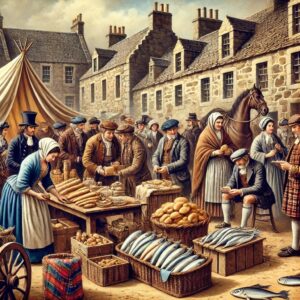
Life in Scotland in 1792 was vastly different from today. The country was still largely rural, though the Industrial Revolution was beginning to take hold, especially in towns like Glasgow and Edinburgh. For the average Scotsman, wages were modest, and careful spending was essential to make ends meet.

The economy was based on pounds (£), shillings (s.), and pence (d.), with 1 pound equaling 20 shillings and 1 shilling equaling 12 pence. Understanding the cost of everyday items in 1792, and how they compare to today’s prices, gives us a fascinating glimpse into the daily life of an 18th-century Scot.

Let’s explore what a Scotsman could buy in 1792, using historical prices alongside their modern equivalents in both British pounds (£) and US dollars ($).

Wages and Income in 1792

Before looking at prices, it’s important to understand how much people earned in 1792. Wages varied depending on the job, but here are some averages:

  • Farm laborer– 10 to 12 pounds per year (£1,900–£2,280 or $2,600–$3,100 today)
  • Skilled tradesman (blacksmith, carpenter, tailor, weaver, etc.)– 15 to 25 pounds per year (£2,850–£4,750 or $3,900–$6,500 today)
  • Domestic servant (male)– 8 to 10 pounds per year (£1,520–£1,900 or $2,000–$2,600 today)
  • Domestic servant (female)– 5 to 8 pounds per year (£950–£1,520 or $1,300–$2,000 today)
  • Minister or schoolteacher– 30 to 50 pounds per year (£5,700–£9,500 or $7,800–$13,000 today)
  • Wealthy merchant or landowner– 100+ pounds per year (£19,000+ or $26,000+ today)

Since many farm laborers and domestic workers received food and housing as part of their employment, their wages stretched further than those of independent workers.

The Cost of Food in 1792

Food was a major expense, and while basic staples were affordable, luxuries like tea and sugar were expensive.

Basic Staples

  • Oatmeal (peck, ~9 liters)– 1 shilling 2 pence (£5.50 or $7.50 today)
  • A loaf of bread (quartern loaf, ~4 lbs.)– 4 pence (£1.58 or $2.10 today)
  • Milk (per pint)– ½ penny (£0.20 or $0.26 today)
  • Butter (per pound, 24 oz.)– 10 pence (£3.95 or $5.40 today)
  • Cheese (per pound, 24 oz.)– 6 pence (£2.38 or $3.20 today)
  • Eggs (per dozen)– 6 pence (£2.38 or $3.20 today)
  • Potatoes (per small peck, ~20 lbs.)– 8 pence (£3.15 or $4.30 today)

Meat and Fish

  • Beef (per pound, 16 oz.)– 4 pence (£1.58 or $2.10 today)
  • Mutton (per pound, 16 oz.)– 4 pence (£1.58 or $2.10 today)
  • Pork (per pound, 16 oz.)– 4 pence (£1.58 or $2.10 today)
  • A good leg of lamb– 7 pence (£2.75 or $3.75 today)
  • Salted herring (per dozen)– 3 pence (£1.19 or $1.60 today)
  • Salmon (fresh, per pound)– 2 pence (£0.79 or $1.10 today)

Beverages

  • Ale (per quart, about a liter)– 2 pence (£0.79 or $1.10 today)
  • Whisky (per bottle, ~750ml)– 1 shilling (£5.00 or $6.80 today)
  • Tea (per pound, ~450g)– 6 shillings (£30 or $41 today)
  • Sugar (per pound)– 1 shilling (£5.00 or $6.80 today)

The Cost of Clothing

Most Scots wore simple, durable clothes that were patched and repaired many times before being replaced. New garments were costly.

  • A woolen greatcoat– 10 shillings to 1 pound (£50–£100 or $68–$136 today)
  • A pair of breeches (men’s trousers)– 6 shillings (£30 or $41 today)
  • A linen shirt– 3 shillings (£15 or $20 today)
  • A woman’s wool dress– 12 shillings to 1 pound (£60–£100 or $82–$136 today)
  • Stockings (per pair, wool or linen)– 1 shilling 6 pence (£7.50 or $10.20 today)
  • Leather shoes (men’s, per pair)– 5 to 7 shillings (£25–£35 or $34–$48 today)
  • A bonnet (Scottish hat)– 2 to 3 shillings (£10–£15 or $14–$20 today)

Housing & Rent

Most farm laborers and domestic workers lived rent-free in cottages provided by their employers, but those renting had to budget carefully.

  • A small rural cottage (one-room, thatched roof)– 2 pounds per year (£380 or $520 today)
  • A modest house in a town (two rooms, stone-built)– 3 to 5 pounds per year (£570–£950 or $780–$1,300 today)
  • A wealthy merchant’s townhouse (large stone home)– 10+ pounds per year (£1,900+ or $2,600+ today)

Transportation & Travel

  • Hiring a horse for a day– 2 to 3 shillings (£10–£15 or $14–$20 today)
  • Stagecoach from Edinburgh to Glasgow (42 miles)– 8 shillings (inside), 4 shillings (outside) (£40 or $55 inside, £20 or $27 outside today)
  • A ferry crossing (small river, per person)– ½ penny (£0.20 or $0.26 today)

Final Thoughts: Could You Live on a 1792 Scotsman’s Budget?

A Scotsman in 1792 could survive on £10–£12 per year, but luxuries were far out of reach for most. While food was affordable, items like tea, sugar, and fine clothing were expensive.

Adapted From: Watson, T. (1894). Kirkintilloch: Town and parish. Glasgow: John Smith and Son

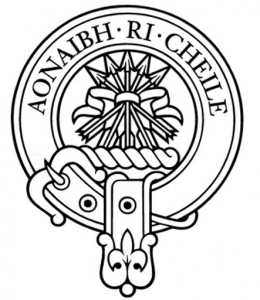
Scottish crest badge is a heraldic badge worn to show allegiance to an individual or membership in a specific Scottish clan. Crest badges are commonly called “clan crests“, but this is a misnomer; there is no such thing as a collective clan crest, just as there is no such thing as a clan coat of arms..

Crest badges consist of a heraldic crest and a motto/slogan. These elements are heraldic property and protected by law in Scotland. Crest badges may be worn by anyone, but those who are not legally entitled to the heraldic elements wear a crest badge that incorporates a strap and buckle, which indicates that the wearer is a follower of the individual who owns the crest and motto.

Crest badges are commonly worn by members of Scottish clans. These badges usually consist of elements from the clan chief’s coat of arms. Clan members who wear their chief’s crest and motto surrounded by a strap and buckle show they are members of the chief’s clan (family).  Although so-called “clan crests” are commonly bought and sold, the heraldic crest and motto belong to the chief alone and never to the individual clan member.

Crest badges, much like clan tartan, do not have a long history and owe much to Victorian era ramanticism, having only been worn on the bonnet since the 19th century. The original badges used by clans are said to have been specific plants worn in bonnets or hung from a pole or spear.


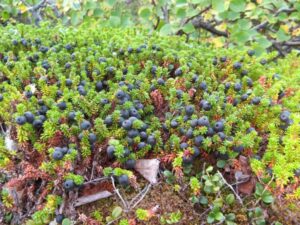
Crowberry, attributed to the Camerons, Macfies, and Macleans.


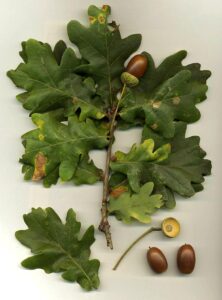
Oak, attributed to the Buchanans,Camerons, Kennedys, Macfies, Stewarts, and Woods.


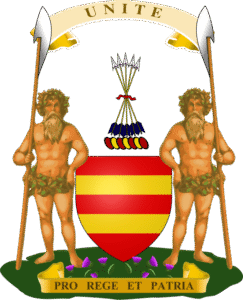
Clan Cameron Crest Badge


Arms of The Lochiel Sir Donald Cameron of Lochiel, the 26th Chief of Clan Cameron (1910 – 2004)

Reference  Scottish crest badge

In the 18th century, the tartan was a symbol of rebellion. After the failed Jacobite Rising of 1745, the British government cracked down hard on Highland culture. The Act of Proscription (1746) banned Highland dress, including the tartan, in an effort to suppress clan identity and quash future uprisings. For decades, to be seen in a kilt was to risk arrest—or forced conscription into the army.

Ironically, this brutal suppression only served to romanticize the garb. When the law was finally repealed in 1782, the tartan had become an emblem of nostalgia and resistance. But the garment still remained largely in the shadows—revived mostly during military parades, Highland games, and the occasional noble family event.

Then came Queen Victoria, who did not just revive the tartan—she transformed it into a global fashion.

Victoria and Albert’s Highland Obsession

Queen Victoria first visited Scotland in 1842, just five years after her coronation. She and Prince Albert were instantly captivated by the landscape, the culture, and the romanticized image of the noble Highlander. This wasn’t just a casual admiration—it became a full-blown obsession.

In 1848, they acquired Balmoral Castle, a baronial estate in Aberdeenshire that would become their beloved Highland retreat. But they didn’t just move in—they redesigned it. Albert personally helped redesign the castle in the style of a traditional Highland residence, and Victoria set about transforming its interiors into a shrine to all things Scottish.

That included the tartan.

They commissioned their own royal tartan: the Balmoral Tartan, a subdued grey pattern with red over-checks. Strictly speaking, it has remained a royal exclusive—only members of the royal family and the Queen’s piper are allowed to wear it. But the symbolism was clear: tartan had gone from outlawed cloth to royal uniform.

A Royal Seal of Approval That Changed Everything

The Queen’s visible enthusiasm for tartan sparked a cultural shift. Suddenly, tartan wasn’t just acceptable—it was fashionable.

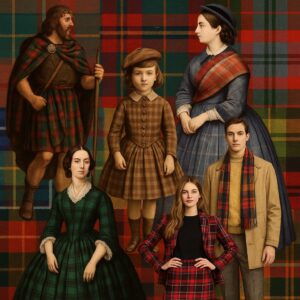
Aristocrats began reviving old family patterns, commissioning new ones, and wearing them at public events. If you didn’t have a clan tartan, no problem. You could now adopt one—many Lowland and even non-Scottish families did just that. Tailors across Britain, and eventually the Empire, began marketing tartans to customers with little or no Highland connection.

Prince Albert helped standardize these patterns. He took a personal interest in organizing tartans by clan and recording their designs, laying the groundwork for what would become the Scottish Register of Tartans more than a century later.

Soon, tartan décor began popping up in everything from drawing rooms to nursery wallpaper. At Balmoral, Queen Victoria’s servants were reportedly decked out in full Highland garb. Even her dogs had tartan blankets. The royal children wore mini-kilts. Artists were commissioned to paint Highland scenes filled with romanticized details—fierce clansmen, misty glens, and lots and lots of plaid.

Tartan Tourism and Global Impact

The Queen’s affection for the Highlands made Scotland a must-see destination for the fashionable elite. Train lines expanded, inns multiplied, and tourism boomed. Guidebooks flourished. English tourists arrived by the thousands, eager to drink whisky, hunt stags, and—most importantly—buy tartans.

Manufacturers in places like Stirling, Perth, and Edinburgh expanded production to meet the rising demand. Some even invented new tartans to satisfy it—patterns with little historical basis but plenty of romantic appeal. Names like “Jacobite,” “Freedom,” and “Caledonia” sold well regardless of their authenticity.

The export of tartan wasn’t limited to Scotland either. In Canada, Australia, and the United States, Scottish emigrants proudly wore their clan’s patterns—often reinforced by Victoria-era family lore. Even American presidents began to embrace tartan as a mark of distinguished heritage. By the 20th century, tartan had transcended its Scottish origins to become a worldwide symbol of heritage, rebellion, and even punk fashion.

From Rebellion to Royalty—and Beyond

Queen Victoria didn’t invent tartan, but she undeniably resurrected it. What was once a proscribed, regionally limited form of Highland expression became a royal-endorsed, internationally recognized symbol of identity. Her passion for the Highlands helped reshape British—and global—perceptions of Scottish culture. What had once been seen as backward, tribal, and dangerous was now elegant, romantic, and desirable.

Thanks to Queen Victoria, tartan has endured not just as a fashion but as a living heritage. Whether it’s in a regiment’s dress uniform, a punk rock stage outfit, or a hipster’s scarf, tartan still carries the echoes of both rebellion and royalty. It is, perhaps, the only fabric in the world that can claim both.

Adapted From: Moncrieff, A. R. H., & Palmer, S. (1904). Bonnie Scotland. A. & C. Black.

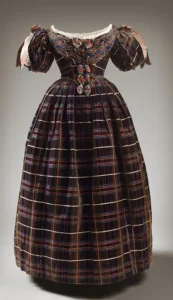
Queen Victoria’s Tartan Dress

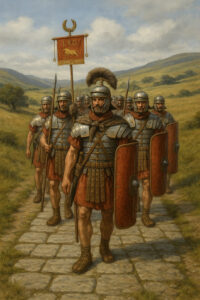
When Agricola pushed beyond Hadrian’s future frontier in AD 79, he faced bigger challenges than Pictish spears: boggy uplands, thick forest and 400 km of empty map between legionary supply depots. Rome’s solution was the thing it always trusted most—a road. The imperial engineers extended the already famous Watling Street (Dover → Londinium → Wroxeter) north-west to Chester, then swung it almost due-north as a fresh trunk artery that modern scholars call Dere Street. Whether you prefer the older Anglo-Saxon name “Wæclinga Stræt” or the academic tag “RR 8”, the brief was simple: a direct, all-weather corridor linking York to the fort-and-harbour complex at Inveresk on the Firth of Forth. Food, pay chests, dispatch riders—and, crucially, reinforcements—could now cover that distance in ten hard days of marching instead of three anxious weeks by cart-track.

How to Build a Road That Lasts Two Millennia

Roman surveyors used the groma to sight long alignments, then teams of legionaries and hired locals did the heavy lifting:

  1. Agger– A cambered embankment of earth and turf gave instant drainage.
  2. Statumen– Fist-sized stones were packed as a foundation.
  3. Rudus & Nucleus– Layers of gravel and clay, sometimes beaten with pila tampers, formed a concrete-like core.
  4. Summum dorsum– A paving of gravel, or in wealthy zones flat stone slabs, provided the final running surface.
  5. Margines & fossae– Turf kerbs and flanking ditches kept edges crisp and water away.

At Soutra in the Scottish Borders a 40 m slice shows the agger still two metres high. The Newbridge dig outside Edinburgh even found a log-raft base laid over a prehistoric watercourse—proof that Roman road-builders could improvise suspension bridges of oak brushwood when geology refused to cooperate.

The Route, Stage by Stage

Chester (Deva) to Carlisle (Luguvalium) followed the Dee valley, but the stretch we feel underfoot in Scotland begins when Dere/Watling crosses the Tweed near Jedburgh:

  • Jedburgh → Trimontium (Melrose)– A straight climb over the Cheviots: look for the grass-crowned agger on the A68 verge.
  • Trimontium → Soutra Hill– Here the road crests 370 m; on a clear day recruits glimpsed the silver Forth for the first time.
  • Soutra → Vogrie → Sheriffhall– The line skirts Dalkeith; lidar surveys have revealed twin ditches flanking the agger through Midlothian farmland.
  • Sheriffhall → Inveresk– The last 5 km is the best-preserved. Turf-walled “lane” Patten described in 1547 still guides the modern footpath to St Michael’s hill. Beneath Inveresk House a vaulted passage shows the same rammed gravel floor that once took cart-traffic straight into the fort’s south gate.

Onward traffic diverged: one spur dropped to the port at Fisherrow (the Auld Brig still sits on Roman oak sleeper beams), while another swung west toward Cramond and the Antonine Wall, delivering men and masonry for the short-lived northern frontier.

Why It Still Matters

Dere/Watling remained Scotland’s spinal road long after the eagles flew home. Medieval drovers drove cattle on it; Edward I marched to Falkirk along it in 1298; today stretches hide beneath the A1, A68 and even Edinburgh suburban lawns. Each excavation adds a footnote: in 2024 archaeologists under London’s Old Kent Road exposed a pristine length, its gravel capped by two chalk layers—textbook Roman road-craft visible like a layer-cake.

The discovery sent fresh eyes north, where ground-penetrating radar is now tracing the missing link across Dalkeith Country Park.

Why visit? Because standing on that cambered ridge at Soutra or walking the tree-lined lane into Inveresk you feel a direct line—physical, not metaphorical—connecting Dover’s White Cliffs to the Lothian coast. Few bits of infrastructure on earth can claim 1,900 years of more-or-less continuous service. Fewer still end at a Roman bathhouse floor you can touch under a Georgian garden. The next time your sat-nav starts barking directions on the A68, remember: it’s mostly following instructions first scratched on a tabula in AD 80.

Adapted From: Stirling, R. M’D. (1894). Inveresk parish lore: From pagan times. Musselburgh: T. C. Blair.

When the last echoes of musket fire faded from the field at Culloden in 1746, so too began the long fading of the ancient Highland clanship system. The Jacobite Rising of 1745, with its romanticism and tragedy, was the final stand of a society built on kinship, loyalty, and honour. It was not merely a failed rebellion—it was a cultural turning point. In its wake, Highland society was forcibly reshaped, and one of the most distinctive social systems in Europe was slowly dismantled, not by swords, but by policy, paperwork, and profit.

The chief, once the embodiment of clan identity—a father, judge, warrior, and protector—was gradually transformed into a landlord, a legal owner rather than a kinsman. This transition marked the disintegration of clanship as both a political and cultural structure.

Before 1745, the chief’s power stemmed from mutual obligations. He protected his people, and they in return gave military service, labour, and loyalty. This was not tenancy in the modern sense—it was a relationship based on blood and shared history, often remembered in oral tradition, bards, and battle stories. The chief’s authority was more moral than administrative. But by the late 18th century, these relationships had eroded under increasing external pressure

Weapons Down, Rents Up: Legal Changes and Social Reconfiguration

After Culloden, the British government acted decisively to crush the power of the clans and prevent further uprisings. They passed a series of laws designed to break the spine of the Highland way of life:

  • The Disarming Act(1746) made it illegal to carry weapons.
  • The Dress Act(1746) banned the wearing of Highland dress, including kilts and tartans.
  • The Heritable Jurisdictions Act(1747) stripped chiefs of their feudal powers of justice.

No longer could a chief hold court or command an army. He became, in essence, a landed aristocrat subject to London’s laws, not Highland custom. Over time, many embraced this new identity. As their former military and judicial authority vanished, chiefs began to act like landlords in the English sense, collecting rents and focusing on profit rather than kinship.

This transformation was accelerated by the spread of capitalist ideology. Rather than seeing clanspeople as extended family, many chiefs came to see them as economic liabilities or assets. In the past, the chief’s wealth was measured in men—how many warriors he could raise. By the 1800s, it was measured in money.

As sheep farming and later deer stalking proved more lucrative than traditional tenant farming, the stage was set for the most painful chapter in Highland history: the Clearances.

Eviction by Kin: The Highland Clearances and the Betrayal of Trust

From the late 18th to mid-19th century, thousands of Highlanders were forcibly removed from their ancestral lands in waves of evictions collectively remembered as the Highland Clearances. These were not perpetrated by foreign invaders or lowland elites—but often by the very chiefs who were once seen as clan fathers.

The betrayal was not just economic—it was existential. To Highlanders, being cleared by one’s own chief was akin to being disowned by a parent. It upended centuries of trust and spiritual connection to land and leadership. Gaelic culture—which included communal herding, seasonal transhumance to the sheilings, oral tradition, and fierce clan pride—was gutted not only by loss of place, but by the loss of identity.

Some chiefs sold their lands to Lowland speculators or English industrialists, escaping the burden of communal responsibility. Others, seeing themselves as part of a modernizing Britain, believed they were acting in the best interests of development. But for the evicted, modernization was a cruel euphemism. Crofters were pushed to the coasts, given barren plots, or shipped abroad—to Nova Scotia, Australia, or America.

The names of the most infamous evicting landlords—Patrick Sellar, the Duke of Sutherland, and even once-revered clan leaders—are now remembered with bitterness. The Gaelic lament songs of this era are filled with sorrow and fury. The soul of a people was not only dispossessed—it was orphaned.

What Remains of the Clan? Legacy, Tourism, and Identity Today

By the mid-19th century, the clan system had all but disappeared as a functional social structure. What remained was symbolic and nostalgic. Tartan was re-legalized and romanticized. Queen Victoria’s visit to Balmoral in 1848 helped create the idea of the “noble Highlander” as a picturesque figure—loyal, brave, and exotic, yet politically harmless.

Many chiefs became ceremonial figures or absorbed into British aristocracy, known more for London society than Highland leadership. Some descendants of cleared Highlanders formed diaspora clans abroad, especially in Canada and the U.S., attempting to preserve their identity from afar. Clan societies sprang up, often more enthusiastic about tradition than their Scottish counterparts.

In modern times, the concept of “clan” has shifted again. Today’s clan chief holds no political power and often serves as a symbolic figurehead. Yet there is a growing movement to reconnect with genuine clan history—not the tartan-and-shortbread version sold in gift shops, but the raw, complex legacy of kinship, struggle, and loss.

The romantic image of Highland culture, deeply rooted in 19th-century literature and Victorian fantasy, masks a painful truth: that clanship did not die with a sword in hand, but was strangled by legal papers, leases, and ledger books. It was a slow betrayal—a tragic fading of communal identity in the name of “progress.”

But memory endures. In songs, stories, and the fierce pride of Highland descendants, clanship still flickers. Not in military allegiance or feudal bonds, but in a longing for a time when kinship mattered more than capital, and a chief was more than a landlord.

Adapted from: Campbell, D. (1886). The Lairds of Glenlyon: Historical sketches relating to the districts of Appin, Glenlyon and Breadalbane. Perth: R. S. Shearer & Son.