
Walk the streets of Belfast or Bangor and you’ll hear it in the vowels, see it in surnames on shopfronts, and taste it in a wheat-and-iron culture of thrift, dissent, and invention. But how much of modern Irish identity—especially in the North—truly bears a Scottish stamp?
The Historical Spine: From Plantation to Partnership (and Friction)
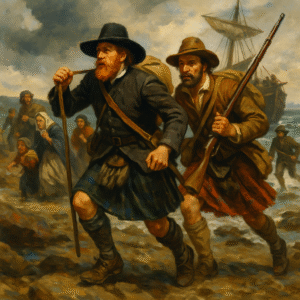
In the early 1600s, waves of Lowland Scots crossed the narrow sea to Ulster. They were pushed by a crowded homeland and pulled by royal charters, leases, and the promise of steadier land. They brought with them Presbyterian structures, a habit of kirk discipline, and a culture of “improvers” who prized literacy, ledgers, and local associations. These settlers did not land on an empty shore. They met Gaelic Irish communities with older claims and deeper roots, meaning Ulster became a layered society: overlapping laws, languages, and loyalties. Conflict followed, but so did exchange.
Across the 17th and 18th centuries, the Scottish imprint took institutional form. Presbyterian meeting houses multiplied; session minutes knitted moral order; dissenting academies taught practical subjects; and voluntary societies—trades, charities, reading clubs—thrived. The ethos was not just religious; it was civic. The same networks that organized congregations also organized credit, apprenticeships, and mutual aid, seeding a culture of participation that persisted long after the muskets fell silent.
Language, Lore, and Everyday Life: The Quiet DNA
If identity lives in the ordinary, then the Scottish influence is most clearly heard in Ulster-Scots speech, seen in place-names, and felt in folkways. Words like “bairn,” “wee,” “aye,” and “scunnered” aren’t imports for show; they’re the lived vocabulary of families and fields. Farm practices—mixed cropping, hedging, careful tenancy—carried Lowland fingerprints. So did patterns of plain architecture: whitewashed walls, symmetrical fronts, thrift in ornament but care in craft.
Foodways tell their own story. Oat-based breads, broths, and the comfort of a fry with soda farls echo across the channel. Music and dance travelled too—fiddles, fife-and-drum traditions, marching airs—later cross-pollinating with Irish styles into something distinctly Ulster. What gets called “Scotch-Irish” in America began as Ulster-Scots at home, and that feedback loop matters: migrants carried tunes, theology, and thrift to Pennsylvania and Appalachia, then sent back money, letters, and a myth of frontier grit that boomeranged into local pride.
Industry, Modernity, and the Civic Mind
By the 19th century, Belfast had become an industrial powerhouse—linen first, then shipbuilding and engineering. Was that “Scottishness” at work? Partly. The connections to Glasgow and the Clyde, the capital networks that stretched through Presbyterian kinship, and a cultural comfort with practical education all mattered. But industry demands more than ancestry. Geography (deepwater harbours), empire (global markets), and Irish enterprise—Catholic and Protestant alike—converged. The “Scottish influence” is real, yet it operated alongside Irish ingenuity and international forces.
Civically, the Scottish stamp shows up in associational life: cooperatives, benefit societies, temperance halls, debating clubs. The Presbyterian habit of electing elders and scrutinizing accounts nurtured a skill set useful for town councils and trade boards. Literacy and pamphleteering, born in sermons and schoolrooms, fed newspapers and reform campaigns. Even when politics divided people, the tools of organization—petitions, committees, minutes—were shared. Identity is often less about who “we” are and more about how “we” do things; on that score, the Scottish mode of doing—methodical, minute-keeping, improvement-minded—left marks.
Folklore vs. Fact: Untangling the Story We Like to Tell
So where does folklore begin? First, in the temptation to treat “Scottishness” as monocausal. It wasn’t. Ulster’s culture is a braid: Gaelic Irish, Anglo-Irish, Huguenot threads, Atlantic trade, and modern media all wound in. Attributing every habit—from thrift to argument—to Scotland is tidy, but it flattens reality and erases exchange.
Second, in the myth of perfect continuity. Traditions change in transit. Presbyterianism in Ulster adapted to Irish soils and British politics; Ulster-Scots speech evolved into its own register; and industrial morals adjusted to urban life. What we call “heritage” is often a remix—selectively remembered, curated in museums and festivals, refreshed by school curricula and tourism boards.
Third, in the politics of memory. Identity stories do work: they defend, dignify, or differentiate. In a place as contested as Northern Ireland, a Scottish lineage can be brand and buffer, just as Gaelic roots can be compass and claim. Both narratives are meaningful; both can harden into caricature. The healthiest identity keeps two truths in view: inheritance matters, and so does encounter.
So, fact or folklore? Both. The Scottish influence is factual in institutions, accents, surnames, settlement patterns, and civic habits. It is folkloric when recruited as a total explanation or a purist badge. The real story is hybrid. Modern Irish identity—especially in the North—has Scottish bones in some places, Irish heart in others, and a shared head for survival and reinvention.
What This Means Today
For ordinary people, this history isn’t an exam to pass; it’s a toolkit. If your community values reading groups, credit unions, fairs, and festivals—keep them. If your family words carry lilt across the Moyle, cherish them. If your street hosts multiple memories—Gaelic, Scots, English—make space for each to breathe. Heritage becomes harmful only when it’s used to close doors rather than open them.
For educators and storytellers, the task is balance: highlight the Presbyterian schoolmasters and the Gaelic poets; trace shipyard ingenuity and linen webs; let pupils hear Irish and Ulster-Scots alongside standard English. Show how migration reshapes both the place that sends and the place that receives—because that is the enduring Irish story, and the Scottish one too.
And for anyone tempted by neat narratives, remember: identity is not a pedigree chart; it’s a living conversation. Scotland’s voice is strong in that conversation, but it is not the only voice—and the harmony is the point.
Adapted From: Harrison, J. (1888). The Scot in Ulster: Sketch of the history of the Scottish population of Ulster. W. Blackwood and Sons.